Serving San Francisco, CA and surrounding areas. (628) 895-9470
San Francisco's soil, hills, and seismic history make foundation installation more involved than in most cities. We handle the engineering, permits, and site work so your foundation is built for where you actually live.
Foundation installation in San Francisco covers new poured concrete foundations, perimeter wall foundations, and full replacements on older homes - most projects take one to three weeks of active construction once permits are in hand, with the permit process itself adding several additional weeks to a few months depending on your project's complexity.
Every foundation installed in San Francisco must be engineered for the city's seismic zone requirements, submitted to the Department of Building Inspection for approval, and inspected during and after construction. San Francisco's varied neighborhoods - steep hillside lots, filled-land areas near the bay, dense blocks with narrow access - each add site-specific challenges that affect how the project is scoped and priced. If your project calls for a ground-level slab rather than a full perimeter foundation, we also handle slab foundation building as a distinct but closely related service.
Drainage around the foundation - grading, waterproofing membranes, and drainage channels - is included in the scope of work on every project, not treated as an optional add-on. San Francisco's wet winters mean a foundation without proper drainage is a foundation that will give you moisture problems within a few years.
If doors or windows that used to open easily now stick, jam, or leave visible gaps at the corners, the structure below them may have shifted. In San Francisco, this is common in older homes whose original foundations were not built to handle seismic movement or decades of soil settlement. Several openings behaving this way at once is worth a professional look.
Cracks wider than a pencil tip, diagonal cracks running from window corners, or cracks that have visibly grown over time are worth taking seriously. San Francisco's soft soils in filled-land neighborhoods can shift gradually, and what starts as a small crack in stucco or concrete can signal ongoing movement underneath.
A floor that slopes noticeably toward one corner, or that has a soft or springy feel in certain spots, can indicate the foundation is no longer providing solid, even support. This is especially common in San Francisco's older Victorian and Edwardian homes, many of which sit on wood post-and-pier systems never designed for the loads modern homes carry.
Standing water, a musty smell, or visible dampness on basement or crawl space walls after rain means your foundation is not draining properly. San Francisco's wet winters and bay-adjacent moisture accelerate this problem, especially in homes where no waterproofing was applied when the original foundation was built.
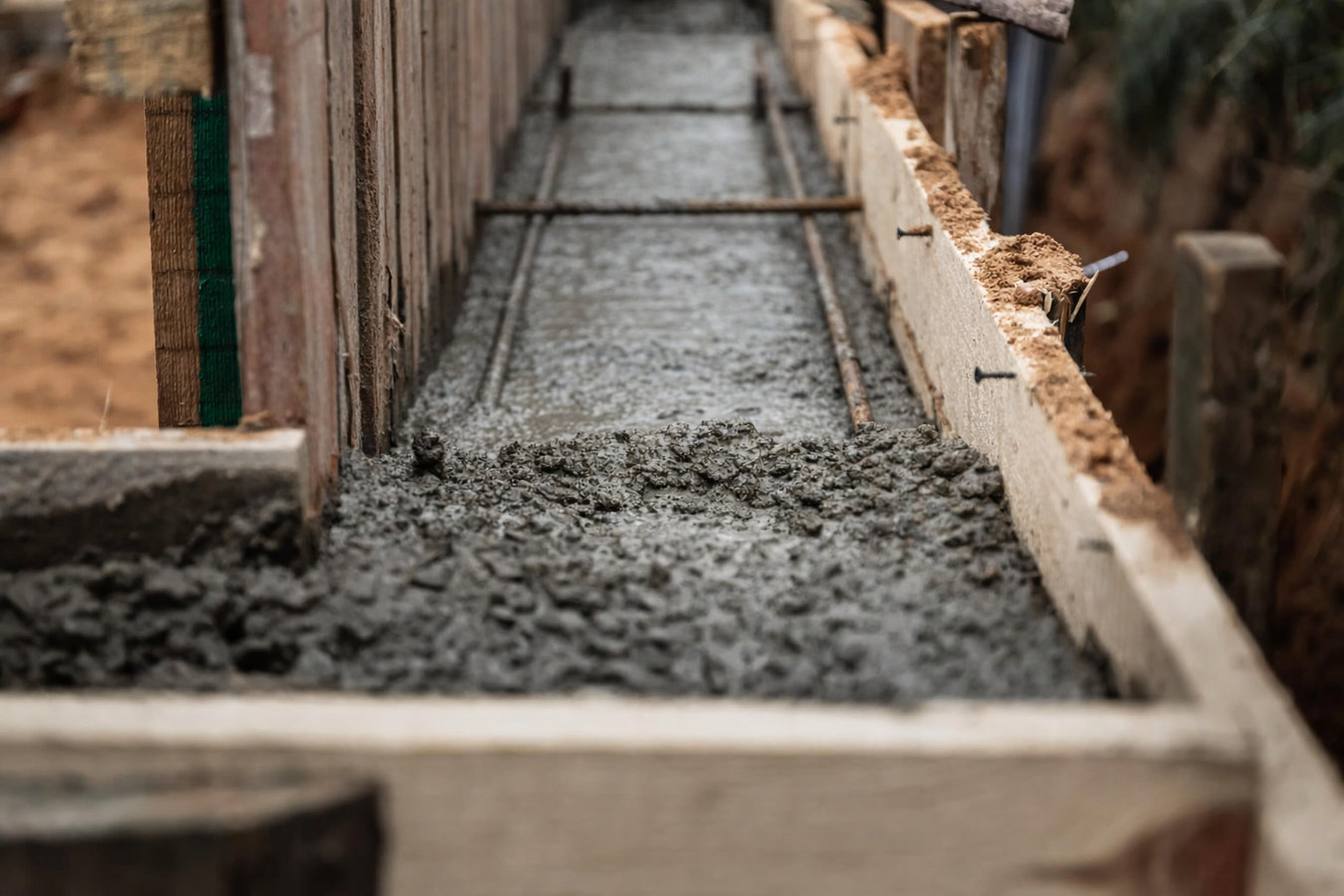
We install new and replacement foundations for residential properties across San Francisco and the Bay Area. Every project includes excavation, temporary shoring where needed to protect the existing structure, forming and steel reinforcement placement, the concrete pour, drainage and waterproofing at the perimeter, backfill, and grading to direct water away from the structure. We coordinate with a licensed structural engineer for the required seismic design and manage all permit submissions with the San Francisco Department of Building Inspection. For properties that need a parking structure or hardscaped surface alongside foundation work, we also handle concrete parking lot building so the two scopes are coordinated from the start.
San Francisco's older housing stock - many Victorian and Edwardian homes built before modern seismic codes - often requires replacing original wood post-and-pier systems or unreinforced concrete perimeter walls with modern reinforced foundations. This kind of work is very common in San Francisco, and we have completed it on hillside lots, narrow urban parcels, and dense blocks where access requires careful staging. If your project also involves working on or under an existing slab, we coordinate that work alongside the foundation installation.
Suits new construction or major additions requiring a full reinforced concrete perimeter foundation engineered to current seismic standards.
For Victorian, Edwardian, and mid-century San Francisco homes whose original foundations no longer meet current safety standards or are showing signs of failure.
For properties where moisture management is a priority - includes waterproofing membrane, drainage channels, and grading to protect the foundation long-term.
Suits homeowners extending their home's footprint whose existing foundation cannot support the new load without a new or extended perimeter foundation.
San Francisco sits near both the San Andreas and Hayward fault systems, and every foundation installed in the city must be engineered for that reality. The city's building code requires lateral force resistance details that go well beyond what contractors in most other cities routinely specify. Parts of San Francisco - the Marina, Mission Bay, and bay shoreline neighborhoods - were built on filled land that behaves differently from natural ground, especially during seismic events. The California Seismic Safety Commission publishes plain-language guides on what earthquake-resistant construction involves - these materials can help you ask better questions when interviewing contractors and understand what you are paying for.
San Francisco also has one of the oldest housing stocks on the West Coast. A large share of the city's single-family homes were built before 1950, many on foundations that predate modern seismic requirements. Replacing or upgrading these foundations requires navigating both the city's permitting process and the structural realities of connecting a new foundation to a century-old wood frame. Homeowners in Oakland and Berkeley face the same combination of old housing stock and seismic requirements, and we work across both East Bay cities with the same engineering-first process.
Foundation work cannot be accurately priced without seeing your property. We schedule a site visit, review your existing conditions and goals, and ask about any known soil issues or previous foundation work. Expect the visit to take an hour or two. We respond to all new inquiries within one business day.
We coordinate with a licensed structural engineer to produce stamped drawings meeting San Francisco's seismic requirements. We submit those drawings to the Department of Building Inspection and manage the review process - including any city requests for revisions. You do not need to track this yourself.
Once permits are in hand, the crew excavates to the required depth, removes any old foundation material, sets forms, and installs reinforcing steel. A city inspector verifies the steel placement before any concrete is poured - this inspection is required and cannot be skipped.
The concrete pour is typically completed in a single day. We add drainage and waterproofing at the perimeter, backfill, and grade the site for water management. After curing, a final city inspection closes out the permit. We hand you the closed permit documentation - keep it, as you will need it for future permits or at resale.
Permit timelines in San Francisco move slowly - the sooner you start, the sooner your project is done. Free on-site estimates, written bids, no pressure.
(628) 895-9470San Francisco's earthquake risk is not abstract - it shapes how every foundation here must be built. We coordinate with a licensed structural engineer on every foundation project, and the finished work is inspected and documented to the city's seismic standards. You receive the closed permit as proof.
San Francisco's Department of Building Inspection is known for a thorough process that can take months on complex projects. We handle the application, track the review, and schedule required inspections so the permit process does not stall on your side. Local experience with the city's process is something you will not get from a contractor who does not work in San Francisco regularly.
In neighborhoods built on fill - the Marina, Mission Bay, and parts of the Richmond and Sunset - the ground under your property can require a geotechnical investigation before the city issues a permit. We assess your site address at the start so there are no mid-project surprises that change your budget.
The USGS Earthquake Hazards Program publishes up-to-date hazard maps for the San Francisco Bay Area. We use these resources to understand the seismic context for each project location - and we encourage homeowners to review them too, so you understand why the engineering requirements for your project are what they are.
Foundation installation in San Francisco requires more than concrete and a crew. It requires local experience with the city's permit process, seismic engineering coordination, and the judgment to assess each site on its own terms. That combination is what protects your investment and keeps you clean at resale.
Commercial and residential concrete parking surfaces designed for durability, proper drainage, and San Francisco's permit requirements.
Learn MoreGround-level concrete slab foundations for new ADUs, garages, and additions - permitted and engineered for San Francisco's seismic zone.
Learn MorePermit review queues in San Francisco are long - the sooner we submit your plans, the sooner your project moves. Call us today or request a free on-site estimate.